If you want to know what Britain was like before The Festival of Britain you should watch the masterful 1950 film noir, Night And The City. It features a chase around the industrial chimneys and postwar rubble of what was to become the Southbank Festival site.
Richard Widmark; Night And The City (1950)
Watching the rather wonderful BBC2 documentary on the Festival last night revealed uncomfortable as well as pleasant truths. While a whole generation of talented young designers and architects got real creative freedom (including refugees from Hitler’s Germany), working through the nights till opening day, none were invited to the grand opening ceremony. A perfect insight into the rigid and thoughtless snobbery of the political classes.
But the Festival itself was open to all and many felt the liberation of celebration. Joe Orton, even managing to get laid there, according to Prick Up Your Ears.
Until a couple of weeks ago you could visit a wonderful museum of 1951 which had been open much of the summer in the old Gamelan Room of the Royal Festival Hall. Full of original designs, furniture, film clips and memorabilia, it was closed and stripped out only a few days before the BBC2 documentary screened; a shame. The documentary revealed the stupidity of the new 1951 Government which insisted on tearing down the Festival buildings against strong public opinion as soon as the summer season was up. The documentary voice over pointed out that the new Tory administration couldn’t wait to knock down what was a Labour success and redevelop the site. The concrete ugliness of the brutalist National Theatre/Film Theatre complex that eventually got built reveals more parallels with modern architects’ and politicians’ enduring failure to appreciate good existing design principles.
British engineering and science were highly valued at the time and the pavilions were full of real innovation and ideas. My father-in-law, a future industrial chemist, remembers the inspiration reaching Belfast, where all he and his classmates doodled the Skylon endlessly on their exercise books, While we still have our Dysons and Trevor Baylisses, and the Government will fund science programmes at Universities, the dramatic slashing in higher education funding contrasts dramatically with the hope generated by new universities and polytechnics in the 50s. Unlike the 50s, Britain is coming out of a period of binge spending into austerity. It is a new world indeed.
Not The Festival of Britain
Compare another Labour-Conservative tussle — The Millennium Dome. A shape and a public image first, then came the thinking about what to fill it with. Major corporate sponsors and fast food concessions. From the 2 hour security queues to get in on a freezing New Year’s Eve, to the rather miffed looking Queen forced to link arms for a giant pub crowd rendition of Auld Lang Syne, the Dome was a symbol of Cool Britannia’s hollowness. I spent much of my first year as a reporter on Channel 4 News covering the latest tinkerings to try to pull in higher attendance.
By the summer they had decided to build a mini Wembley stadium replica for a Football Zone, while the real one was earmarked for demolition at the other end of the Jubilee line. PY Gerbeau, the man who rebranded EuroDisneyland with a Paris on the end, had been brought in to revive it. And then, just as everyone had got used to it, the government decided to close it down and sell off the contents. Millions of pounds of state of the art audio visual equipment got sold off at knock down prices. It was an all too familiar and rather shabby “everything must go” end. Unlike The Festival of Britain, though at least the public got a chance to own a piece of it.
In Night and The City Richard Widmark is a weaselly ex-GI always on the make. Instead of living the American dream, he’s become a British lowlife — trying to make a fast buck out of illegal gambling and forged drinking club licenses in the rubble of an old London. The clean and shining new buildings and values of the Festival of Britain aimed to wipe that all away. But 60 years on?
The bitter copyright dispute over the Keep Calm and Carry On logo is emblematic of how the Britain that once could make do and mend, has become contaminated by the imported TV values of The Apprentice. The combination of greed and hypocrisy has always been a potent British home brew, like in Night and The City. Now in a plot worth of an Ealing comedy, the man at the centre of the trademark row is a former producer of Who Wants To Be A Millionaire. On the moral high ground is the Northumbrian second hand bookshop owner Stuart Manley who actually found the surviving poster, but had the quaint old fashioned idea that it represented something more than money, and belonged to all of us.
What happens when the ultimate West Coast musician takes on the ultimate East Coast sound? You get a lot more xylophones in Gershwin.
(God Only Knows performed at the Royal Festival Hall in 2002)
Brian Wilson says he did an album of Gershwin at the suggestion of the Gershwin family. There are two numbers that are astoundingly good — They’ll Never Take That Away From Me — turned into a drum pounding surf number- and I Got Rhythm — transmuted into pure rock n’ roll. Those are the two tracks I’d recommend downloading onto your MP3 player.
But the rest of the album, even with good orchestration, plenty of xylophones, and a string quintet, played out to fill the 40 min first half, veered too often towards easy listening — too Brian Wilson Pops/ jazz flute for me. Still the whole exercise revealed a mind still happiest when noodling around with sounds on a lavish scale.
Surrounded by a very strong 14 piece band, and help on hand when he moved from keyboard to guitar,Wilson, clearly mentally fragile, seems to have constructed a good sized comfort zone around him.
God only knows there’s no place more depressing than London on a miserable Sunday night, but in a baby boomer packed audience, on a rainy night in austerity Britain, where most of the men bopping with enthusiasm, looked like Vince Cable, but far far happier, it was the generous 1 hr and 40 min second half — back to back greatest hits of the Beach Boys, with a little Chuck Berry for good measure — which lifted spirits much as the Festival of Britain must have done here 50 years ago. If you’ve never seen a percussionist doing Pete Townsend style windmilling on a xylophone in the climax to Good Vibrations, then, here was your chance.
Some of us had come to see a legend we’d been born too late to catch in his prime. Many more were here to remember their own prime.The early surf hits proved remarkably durable and danceable. Younger singers did an impressive job on the vocals on many.Wilson’s voice, clearly a damaged one, was sometimes difficult to listen to on the Gershwin. But when he sang “God Only Knows” (“The best song I ever wrote” he acknowledged to the audience) his fallen voice made you hear the echo of his angelic youthful sound on Pet Sounds. If I were older I’d say I was just crying for my lost youth. As it was I felt I was crying for his, too.
Something happened to Time and our concept of War over the past decade. The Second World War, which still fascinates children today, saw global power shift one way and then the other; a clear victory over Axis (of Evil) power. It seems to be the measure against which the British and US Governments formulated policy and military operation.
But in a span of years, almost twice that of 1939-45 we seem frozen in time. There is no measurable visible victory. In news terms an anniversary is traditionally regarded as proof there isn’t really a story. But the 10th anniversary hangs over us precisely because there has been no closure.
The news cycle in which we journalists operate starts out as a tight one – The early days were struggles to deal with the day to day crises of anthrax attacks in Washington, as we still didn’t know the Who and Why. Impressive investigations saw journalists uncover the trails to Pakistan and elsewhere. The Wall Street Journal’s Daniel Pearl became one of the most tragic victims of that attempt to uncover the Who and Why.
Over the next 2 years there was an attempt to contextualise. Within a year I had been commissioned to travel the Muslim world filming the Channel 4 documentary Islam Unveiled, inspired by the discovery that in his will, Mohammad Atta – the chief 9/11 hijacker who’d apparently hated women so much had requested no women at his grave.
Day to day life went on among the educated urban middle classes in Cairo, Tehran, Istanbul and other cities I visited. Looking back from today, the pre-Ahmadinajad Iran I visited, where cautious reforms were starting to make a real change for the better, is one of the greatest losses in the post 9/11 world.
Over the longerterm documentaries and docudramas — notably The Path to 9/11 with Harvey Keitel attempted a worthy, journalistic chronology of authority failings and individual bravery, including several smart female cops who foiled terrorist attacks. But with that narrative well explored, the wider world changes proved harder to pin down.
Over the years we coined the new term Islamophobia . While some Islamist groups were keen to stir up trouble of their own ( the Danish embassy protests or disrupting the repatriation of dead soldiers at Wootton Bassett) and thrived on the attention when the news media rose to the bait, an equally ugly rise in racist intimidation was also evident. Incidents of women in headscarves being attacked, desecration of mosques and Jewish synagogues. At a lecture I gave about reporting terrorism at the London School of Economics, one German in the audience even compared the bullying atmosphere to the anti-semitic hatred coalescing at the end of the Weimar Republic.
Over this weekend the most moving reflections on 9/11 have been the factual accounts of people who were there or who were bereaved. Particularly moving has been the accounts of children born after their fathers died on 9/11 about their missing parent.
New York novelist, Paul Auster told The World Tonight on Friday that he feared America had turned inward and closed itself to understanding the wider world. Certainly the desecent of Pakistan into chaos is something we watch at a distance now. And yet it’s the nation, most comparable in the impact of extremism and violence, to the experience of European nations invaded by Nazi Germany in the 30s with murderous attacks not just on a Prime Minister, Benazir Bhutto, but on worshippers at mosques, on a visiting cricket team, on liberal judges and politicians.
In Afghanistan too, where Action Aid has been researching the views of women, to coincide with the 10th anniversary of the NATO military campaign, a generation of young girls have grown up, encouraged to believe they could attend school and aspire to achieve in their own right. One wonders what happens to their hopes when their NATO “liberators” withdraw over the coming months?
What I hadn’t guessed at is how a generation of children would grow up with a background of constant war, but a war that was increasingly unreported. When my son went to his first Bonfire night party he thought the fireworks were bombs, thanks to the nightly news coverage of the coalition operation in Afghanistan launched at the end of 2001.
But British audiences tired of it. With no measurable progress to report in these campaigns in Afghanistan and Iraq, we found news audiences began to drop massively; notably after the initial weeks of the Iraq invasion.
10 years on, the news coverage has reduced to the deeply moving, but very brief, ritual naming of the latest fatality; a snap shot and a testimonial about their character from family and commanding officers. The lack of a conscripted army is crucial of course. But, it seems strange that our political coverage operates along separate paths – newspapers raise funds for Help for Heroes – while politicians debate equipment budgets and longterm strategy as if they are unconnected. Vocal opposition remains. Brian Haw’s camp on the doorstep of Parliament was a symbol of it. But he’s gone. And it remains possible for mainstream society to ignore this invisible war.
And day to day we have normalised the fear and the inconvenience – removing our shoes, and belts and bottles of water to go through endless security checks. Govenrments and civil liberties’ groups fight over control orders, “Prevent” anti-extremism programmes in our communities and breaking up bomb plots using fertilisers, and chemicals on airliners.
The self-infecting virus of Islamist radicalism, has forced us to confront the uncomfortable reality of ordinary people, dabbling in terrorist activity, inspired by newscoverage and what they can find online. There was the WH Smith shop assistant, who downloaded weapon making manuals off the internet and worked airside at Heathrow convicted of terrorism. Among the evidence — the Jihadist doggerel this self styled “Lyrical Terrorist” wrote on till rolls about beheading infidels. Her conviction was subsequently quashed on appeal. Only on Friday 9th, 54 year old Munir Farooqi, a Pakistani born British citizen was given 4 life sentences at Manchester Crown Court for radicalising and recruiting for jihad in Afghanistan.
In Oct 2007 the head of M15 Jonathan Evans told the Society of Editors conference of the 2,000 suspected plotters under surveillance. The dilemma for our security services was that success would be the absence of attacks, the deterrance of plots — something that doesn’t make news headlines. Indeed the Farooqi trial made only the inside pages of the newspapers today.
Chris Morris’ masterful Four Lions – recognised the inexplicability and the frightening stupid cruelty of the mass murder of 9/11 and 7/7. He spent weeks in the Old Bailey watching terrorist plot trials as part of his research. It’s the film that should have won the BAFTA when the Academy chose to wallow in more comfortable nostalgia with The King’s Speech.
He, together with the Glaswegian airport worker, John Smeaton, who had a go at one of the terrorist attackers who rammed into the terminal building, reminded us all of a deeper and better truth – a connection, perhaps to the Blitz spirit of the Second World War and the subversive Ealing Comedies that followed. Perhaps time is returning to normal, but without the satisfying arc of invasion, counter attack and decisive victory. Perhaps the smartest thing is indeed, to keep calm and carry on.
Further reading: The Terror Dream by Susan Faludi (Immaculately researched and sourced analysis of 9/11 news coverage and its parallels with the Frontier War against American Indians)
How must the events unfolding in Libya look to exiles? Today I met Jalal Shammam, a Libyan exile who was protesting outside the Libyan embassy in London in 1984 when someone inside opened fire. In an interview for the PM programme he told me how WPC Yvonne Fletcher protected him and other students — she took five bullets. He was shot twice. Other protestors were also wounded. He told me he felt there was little interest in getting his testimony during the original investigation.
Though he still looks young, Shamaam is about 50. He’s spent the prime of his life in exile, and has had sporadic contact with his family in Benghazi, as he says the Gaddafi regime were bugging phones, and threatening relatives there.
He has two concerns. Firstly, suspicion about how new the evidence is of the named suspect that the government’s said it’s pursuing with the new Libyan transitional council. But also his horror at how successful British governments did business with the Colonel despite WPC Fletcher’s murder, Lockerbie and other terrorist atrocities. He described the day Tony Blair met Gaddafi as “the worst day of my life”.
2004 The Prime Minister and The Colonel
Shammam says he’s been protesting outside the Libyan embassy every day for several months and believes many Gaddafi loyalists are still running it. He claimed he and other Libyan dissidents have been harrassed, followed and threatened and that the ousted Ambassador was a scapegoat, while the goons are still in situ.
I was one of many people who tweeted this photograph of the new door mat at the Libyan embassy in London a few days ago. Since the interview today I’m more conscious of the power of simple PR stunts.
While it’s inevitable that the new government will include many formally loyal to the Gaddafi regime, Jalal Shammam’s testimony is a sobering reminder of a hidden human cost of regime change. He does hope to go back home to Libya soon. For the first time in 28 years.
UPDATE: Monday August 15th How interesting that the Prime Minister has today come out with a nation healing speech which concludes with a reference to bankers’ bonuses, MPs’ expenses and an insistence that “There is no them and us. Only us.” (link below)
The FT ran a comment piece a few days ago expressing shock and horror at the riots and talking about “them” and “us”. It was well meant and talked about the affluent “us” needing to make society more inclusive. But it’s striking that the paper felt it could lecture on social cohesion without any need to acknowledge their bling weekend supplement called “How To Spend It” aimed at helping bankers spend those bonuses on 50 thousand pound watches and yachts. Of course spending it is rather different to looting it. And if I have missed a subsequent acknowledgment, I stand corrected.
3 years ago it was all different. But many of those bonuses are now only possible because of the bailout from the taxes of people like the Reeves of Croydon, whose family business was burned down, the shopkeepers of Stoke Newington who suspect the police were more interested in playing tactics over funding cuts with David Cameron, than protecting their families and properties, and bereaved father Tariq Jahan, who called for calm, instead of blame. In a political culture that costs everything financially, including the value of libraries to local communities, the cost of the riots is, in a strictly monetary sense, a lot lower than the cost of bailing out the banks.
"Take Every Advantage" Police protect Niketown, Oxford Circus 8 August. The riots were several miles away.Photo copyright Richard Turner
Watching the looters target electronic warehouses and carefully try on branded trainers, (apparently a photo exists showing a pile of abandoned Adidas ones) it seemed odd that certain media organisations and politicians did not want to look at the culture — other than gang culture, or street culture, or as David Starkey would claim “black” culture. Plenty of good journalists did; including today, in the FT (see link below). But politicians especially don’t want to acknowledge the centrality of consumer culture to modern British identity and how its promotion might help explain, though certainly not excuse, the mess we’re in.
Last year the National Audit Office said bailing out the banks cost UK taxpayers £1.5 billion pounds a year; that’s on top of the billions paid out initially. Meanwhile politicians, whose normalised expense fiddling took millions of taxpayer revenue to fund second homes, continue to challenge attempts to impose an austerity culture on their generous final salary pension lifestyles.
None of this explains away the rioting or excuses it. With racial and class prejudices also rising to the surface, local councils following the PM’s encouragement, trying to evict as yet unconvicted alleged looters, this may be a dangerous time. But there’s also much more awareness by voters of some politicians’, financiers’ and media’s biased agendas. This potentially creates more common ground than division among Britons of all ethnicities. Russell Brand’s unexpected intervention from the Hollywood Hills is the most striking evidence of that. The Riot Wombles of the Riotcleanup campaign were a good example. Crucially attempts by the powerful to claim the moral highground and lecture about “them” and “us” are more likely to backfire now than 3 years ago.
Recommended further reading:
A politician who has made the link. Simon Hughes (The Guardian)
Fascinating piece by Rupa Huq on the riots in Ealing — the Queen of the Suburbs. (The Guardian)
The first rule of presenting the Proms is.. No one wears red at the Proms.
The second rule of Prom club is.. No one wears open toed shoes on the stage of the Royal Albert Hall. (This is apparently a health and safety thing, rather than a Victorian taste issue about British men in sandals).
I am presenting my first Proms this month. While I’ve attended one as an audience member last year, my experience of them, like most people’s has been of watching them on the telly.
But I have a secret. The Royal Albert Hall haunts me. It is like Devil’s Tower, Wyoming, in Close Encounters of the Third Kind. I may not have sculpted it out of mashed potato like Richard Dreyfuss, but it has drawn me to it inevitably. It has been the scene of wild visions — watching, late at night, and already half dreaming, as Michael Caine battled an assassin on its steps in The Ipcress File. Hitchcock’s The Man Who Knew Too Much, whose Bernard Hermann music opens Prom 38 on Friday, also features an attempted assassination at the top of the Victorian dome.
It has also been the setting for, amongst other things, one of the most terrifying nightmares of my life, a meeting with the crew of the Starship Enterprise, and my one and only singing performance on a major world stage.
Let’s start with the singing. Because I am one of the lucky few, whose first entry to the Royal Albert Hall was to perform there. A 15 year old south London school girl first wallked up the Bull Run entrance onto the stage on December 21st 1983 as part of the Wimbledon High School Choir, singing at a concert for Save the Children.
Folksinger Roger Whitaker - Born in Kenya. Still v big in Germany
While New Romanticism and synth pop dominated the charts we were on the same bill as cellist Julian Lloyd Webber, Brideshead Revisited star Anthony Andrews, who came on stage with Donald Duck and Mickey Mouse (both unbilled) and world renowned folksinger, Roger Whitaker. He was (indeed is) a bit like Rolf Harris, but born in British East Africa, not Australia, couldn’t draw cartoons and, according to the concert programme, had recently had a number one on the German Hit Parade.
That first visit in the depths of the 80s recession was formative. I remember only darkness outside. Four days earlier an IRA bomb had exploded very close by, outside Harrods in Knightsbridge, killing 6 people and injuring 90. And my seminal memory of the Albert Hall that day is of running round and round its shabby dark pink circular backstage corridors. Decor wise it seemed as thought it had been frozen in time since the late 60s. The colour was exactly the dark pink on the cover of Cream’s Disraeli Gears.
Albert Hall backstage wall colour circa 1983
The other choir, the Goldsmiths’ Choral Union behaved very well, but the possibilities of running round a circular corridor, trying all the doors was too tempting for us. Two of the wilder girls (and believe me we weren’t very wild in the early 80s in Wimbledon) claimed to have burst in on Mickey and Donald getting into their costumes. I learned later that Disney “characters” are NEVER left without security,so I think this was unlikely.
Photograph: Graeme Robertson (Guardian)
I know what it is to stand high on that stage, gaze out at the blurred array of an audience spread along the curved fringes of its cake tiers. Princess Anne was a shimmering pale blob directly ahead. Red programmes, with the words to the carols bobbed everywhere. I felt both far away and incredibly intimate with every other person there. The lamps glowed, the red velvet seemed to pulsate. It’s appeal, with hindsight is simple. It is a massive mothership, a womb, welcoming us back home.
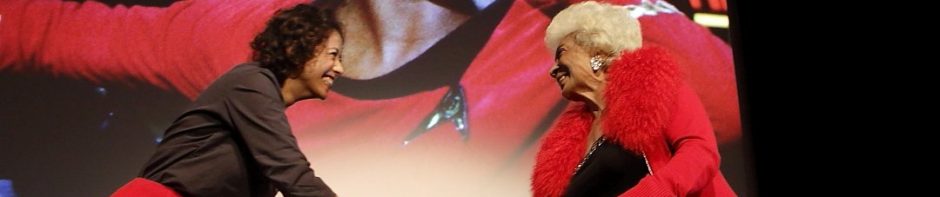
It was to be 12 years later before I came backstage again, as a BBC News Correspondent to report on the UK’s first (and I think possibly only ever) full scale Star Trek Convention. Steampunk was still nascent then, but watching Lieutenant Uhura walk out onto the stage of this Victorian dome amid spotlights and dry ice seemed a most appropriate pairing.
Not long after, when I was working as a news anchor on the BBC World news channel, I had my worst ever work anxiety dream that woke me up, heart pounding in a panic. It involved me presenting a special news bulletin, that went hideously wrong high in front of the organ, in the Albert Hall to an auditorium packed with the most important people in the world including the then Director General of the BBC and the Queen.
The Albert Hall, I realised, in my subconscious, was the ultimate seat of judgment.
A few years on again — it was 9/11 that brought me back to the Albert Hall again, interviewing Nicholas Kenyon for Channel 4 News about why they had decided to change the programme of the Last Night of the Proms, dropping Rule Britannia and Land of Hope and Glory (though not Jerusalem). Some of the hardcore Prommers were rather grumpy about it, but the decision to insert Samuel Barber’s Adagio for Strings, was widely appreciated. I got to sit in an almost empty auditorium listening to American Leonard Slatkin rehearse the BBC Symphony Orchestra just 4 days after the world had changed. My news piece never ran because of the usual timing issues that scupper a longer film when news is breaking all around. But I went home grateful for the experience.
And here I am again, for Prom 26 — a night of French music by Debussy, Ravel and 95 year old Dutilleux. On a hot August morning, I catch the bus from High St Ken tube station, to the waiting Victorian mothership. From the stage door, once the pass has been issued it is but a few steps down to the basement level — no longer Disraeli Gears’ Pink — and it, seems, a lot more bustling, to find Dressing Room 12 which has become the cramped BBC TV Proms production office.
Even at 10am the call sheet reveals a world and a day timetabled to the minute with meetings and rehearsals for the broadcasters and performers. Rehearsals for Proms performers playing on subsequent nights are scheduled into small spaces in the day.
Rule 3 of the Proms seems to be there are no retakes at the Proms. Even though the concert is being recorded for broadcast 4 nights later on BBC4, there will be no more than the 3 allotted minutes for each of my interviews, which have to take place during the interval. First principal clarinettist Yann Ghiro and principal cellist Martin Storey on stage, during which Yann is also going to illustrate the difference between French language and music and German, with a couple of phrases on his instrument. Then a hasty scoot to Dressing Room 6, to interview Chief Conductor, Donald Runnicles.
The fourth rule of Prom club is… there is no autocue at the Proms. And wild ad libbing is not an option. With the rapid flow of the programme (sometimes only a minute or so to fill between pieces) our scripts and agreed question areas are pared down as tightly as possible and printed off to be cut up with scissors and stuck on cue cards. They are re printed and restuck as necessary.The experience of memorising cue cards is a strangely liberating one for a journalist used to the fill-the-airtime- pressures of rolling news. The editor of Channel 4 News was obsessed with the idea that we should never call it a “show”. “It’s a programme.”
But The Proms is proudly a Show. Dressed in a nice 50-style black and white frock, with my black and white 50s TV panel game style cue cards, I am in the right mood. My co-presenter, Proms regular Suzy Klein, up in the Box, shows how it is possible to keep things informal without betraying the special sense of occasion. I learn how even turning around to draw the viewer to look over your shoulder — at an orchestra tuning up — must be done much, much slower than I’m used to, covering a breaking news event.
Meanwhile experienced Proms’ director John Kirkby, is having to deal with problems I’d not anticipated. The televisual challenge of shooting Ravel’s Bolero; a love it or hate it crowd pleaser. You might underestimate how satisfying it is to watch a Prom on TV. How the mix of shots engages you, especially on the more complex pieces like tonight’s Dutilleux. But Bolero, says John Kirkby, is like directing a pop video. You’ve got no option but to cut on the beat. And for 15 minutes. Not just 3. Somehow he finds a way.
There is one more rule of Prom club. “Watch out,” warns one of the production assistants as the concert start time approaches. “Some of the men in the orchestra tend to strip off in the corridors because they don’t want to wait to get changed.” I am on high alert thereafter, but the male members of the BBC Scottish Symphony Orchestra are most gentlemanly; somehow miraculously transforming as the afternoon turns to evening through the rehearsals from t-shirts and jeans to smart black suits and shirts without so much as a bared ankle on show. The ladies dazzle, many in Grecian style dresses.
If you’re lucky and have time, the researcher tells me, one of the best perks of working on the Proms is to sit in on the rehearsal. I do. Inside the Albert Hall it is always Saturday and the rehearsal is like a child’s Saturday afternoon, anticipating the excitement of the night out ahead. But the intimacy of sitting in that giant almost empty auditorium, listening to a great conductor and his orchestra work through ideas out loud, only for you is almost more joyous than the night’s public performance could possibly be.
By 7pm I am ready — standing at the start of the Bull Run, for a rehearsal of the opening, when Suzy and I give a sense of the concert being about to begin. It is fun to be the one facing the camera, as the musicians walk past you up onto the stage, the full auditorium glimpsed beyond, and realise I am not the one performing for that audience.
Watching the conductor from my vantage point, in those moments where he is concentrating hard, before walking on stage to the unique roar of Albert Hall applause is again, strangely intimate. And a privilege.
The interviews in the interval go well. I have no time to revel in being on stage as my back is to the noisy chat-filled auditorium. I have 4 minutes to get to Dressing Room 6, while Suzy interviews her guests in the box. Donald Runnicles comes in in time and gives real insight in just his allotted 3 minutes, into what to expect of the post interval piece — Ravel’s Daphnis and Chloe and convincing me to set aside my doubts about the ballet’s “plot”. (A nymph nearly gets raped.By pirates.) He is immediately off, and I find myself staring at his surprisingly fragile looking baton, sitting on the counter. There is a moment before I think to remind him not to leave it behind.
My work for this Prom is done and I must watch the rest of the concert on the monitor in the Proms’ office. It’s frustrating however beautiful the music. However it turns out I am fortunate enough to miss the Double Bassists stripping off in the corridors after the encore.
And I get to do it all over again on Friday.
Samira presents Prom 38 on Friday August 12th 730pm on BBC4, featuring the film music of John Barry, John Williams, Bernard Hermann, Sir Richard Rodney Bennett and Ennio Morricone. Available to watch on i-player here.
In Jeanine Basinger’s book on the old Hollywood studios’ star-making system, The Star Machine there is a great little section on how Doris Day became a huge name, while the similarly talented and wholesome Rosemary Clooney did not. Basinger put it down to bad studio handling. The studio system broke down in the 60s. But I think there’s an even stronger comparison with Jennifer Aniston, currently struggling in the ambivalently reviewed Horrible Bosses.
Career surgery urgently needed
Like Aniston, Doris Day’s nice girl image has been held against her over the years. Both have been huge television stars, though The Doris Day Show on TV came after her movie career, and she was a top box office movie star from the start. Both have a tomboyishness about their beauty and the way they carry themselves. Day lowered her voice an octave for her favourite ever film role, Calamity Jane,(1953) and watch her strut around her log cabin with her lower lip stuck out. It’s uncannily Aniston-like.
Both Day and Aniston are capable of playing much darker roles. Day’s Oscar nomination was for the very witty Pillow Talk (1959) with Rock Hudson, but her Ruth Etting biopic, Love Me Or Leave Me (1955) showed a gritty jazz singer who rises from being a cheap dance hall girl. Her violent relationship with her gangster husband, played with real menace by James Cagney is a jagged line through the film. It was one of her favourite roles.
Aniston’s not made anything as obviously dark, but she’s capable of so much more and it’s evident on the big screen, though often in supporting roles. Check out the underrated Office Space (1999)– Mike Judge’s charming film about horrible bosses and the soul destroying banality of modern corporate culture. She shines and convinces in her role as a waitress and shows an understated comic timing. Even in a creation as excerable as Marley and Me (about a big dumb kindhearted dog) you are stunned by the depth of her anger and resentment as the fellow journo struggling with new motherhood as her husband’s career takes off. (Incidentally her co-star Owen Wilson is another talented actor who seems to have lost his way.)
Doris Day ‘s sex comedies went wrong when they started to fetishise her “virginity”. That Touch of Mink (1962), with Cary Grant, mainly takes place in and around the hotel room where the deflowering is supposed to happen. It’s excruciating to watch. In the same way Jennifer Aniston’s early solo vehicle Picture Perfect (1997) casts her front and centre as a desperate singleton. Surrounding her with a lacklustre leading man (the now long forgotten Jay Mohr) and a strangely unfeisty Ileana Douglas as her best friend, the film seems to push a bizarre pro-marriage agenda. There is a particularly grating scene where she comes up with a “brilliant” ad campaign for mustard (Aniston is a cute genius copywriter with pigtails and short skirts) while all the men in suits watch.
Perhaps the most intriguing contrast is how Aniston was often cast as a girl, when Day was playing a woman. When Day played an advertising careerist, she was a senior account executive in Mad Men-era Madison Avenue, fighting Don Drapers like Rock Hudson in Lover Come Back (1961), not desperately seeking a fiance like Aniston in Picture Perfect.
Day’s singing and acting skills emerged after an accident as a teenager put an end to Doris Kappelhoff’s promising dancing career. She earned her pre-Hollywood fame as a singer, touring with a band, and did those 10,000 hours of hard graft, which the Malcolm Gladwell Outliers thesis, suggests was the key to great successes. Aniston’s work on the long running Friends TV series may not seem as tough, but I would contend is a fair comparison. She’s a talented, hardworking actor. She just seems to keep getting/taking the wrong part or vehicle.
Doris Day’s public image as the happy girl next door hid a dark private life. While she was no Ruth Etting, her 3 marriages ended unhappily, with her being swindled out of her fortune and still fighting court battles over her earnings into the 80s. At the time I was researching her career for a BBC profile in the mid 90s she was a total recluse; her energy focussed on her animal rescue work. Obviously Marley and Me has a point about the redemptive power of caring for pets. Even now, her website, while promoting new released recordings for the first time in 20 yrs, shows only the Doris Day of long ago.
Picture perfect
I write as a film lover and fan of both actors. Aniston like Day, has, I think, the sympathy of a lot of fans, who remember that simple free photo that she and Brad Pitt released of their wedding. How has an actress, so closely linked to her most famous and much loved character (Rachel from Friends) , found her public persona become so like a character out of her one of her bad films? In the past few days I have found myself watching or listening to her go through the most appalling “interviews” to promote Horrible Bosses in the UK. In the shortest possible leather dress, perfect ironed hair and tanned limbs, still wholesome looking and polite, Aniston went along with some ridiculous pointless banter with minor showbiz reporters who’d brought her a burrito; or asked her to pretend to ask for their phone number. (She declined, politely but firmly.) Jennifer Aston, not being interviewed as a actor, but only the lust object.
Doris Day famously turned down the Mrs Robinson role in The Graduate, saying in her autobiography, “I could not see myself rolling around in the sheets with a young man half my age whom I’d seduced. I realized it was an effective part (Anne Bancroft won an Academy Award for it) but it offended my sense of values.” With hindsight her decision was a smart one, careerwise, even if, for us film goers, it would have been fabulous casting. Because Day, unlike Aniston, grasped that playing desperate women, at such an advanced stage in her career, could/would make her seem desperate.
In Love Me or Leave Me, Doris Day’s Etting now a big success, remembers her grim start performing for gropers for 10 cents a dance. The trajectory of a traditional Hollywood star was to escape a sordid start. Jennifer Aniston needs a dramatic role as strong, to help her essape from the dancehall of cheap comedies.
Or How The Space Shuttle Promised Me The Universe, But Left Me On The Gantry Of Broke Dreams.
Sad truth about how many people will ever walk on another world.Courtesty of XKCD
It seems appropriate that the final Space Shuttle mission launch got pushed off the front pages and main broadcast news coverage by the Murdoch News of the World hacking scandal. I wrote this feature for The Independent about what the Shuttle meant to my generation. Do read it. It’s perhaps the most personal piece I’ve ever written. The graph below, found for me by @arthurascii, quantifies my sadness. The article photos feature my Hubble telescope print of a photo of Saturn that we bought with our wedding present money, a Space Shuttle backpack, mostly hidden 70s worm logo NASA t-shirt, Ladybird books on The Rocket and The Hovercraft, a fridge magnet from Cocoa Beach near Cape Canaveral and a book of Space cross sections, featuring the Shuttle Orbiter. Below I’m adding relevant clips to programmes/events mentioned in the article.
In the article I explain how watching Carl Sagan’s Cosmos TV series was a formative experience for me and helped fuel my hope about the Space Shuttle. His warmth and optimism about the possibilities of space exploration inspired a generation of scientists and dreamers. The powerful Hollywood film, Contact, based on his own novel, used his ideas about worm holes as a “transit system to our nearest stars”.This is the TV show clip that I will never forget.
UPDATED: FRIDAY JULY 15TH 2 senior NI/NewsCorp executives have quit within hours today: Rebekah Brooks and Les Hinton. NI’s Legal chief Tom Crone left earlier this week after more than 20 years. And Rupert Murdoch apologised in person to the family of Milly Dowler for the phone hacking. It’s been the poor moral judgement of his staff that’s proved the tipping point and caused shareholder jitters. Remarkable. My post is about the ethical lessons for all journalists.
In my 20 years in journalism, this is only my second major moral outcry against the news media. Remember this after Princess Diana’s death:
This 1997 cover itself caused a moral outcry
The political row about News International and BSkyB is being amply analysed everywhere else. What makes this scandal different is the blatant criminality of phone hacking and paying police officers. But also that it’s finally turned a harsh spotlight on the abuse of ordinary people by the news media; and particularly of victims of crime and their families — sometimes in collusion with individual police officers. There is a sense of Middle England (to use that journalistic invention) realising they, not celebrities, are the ones being exploited on the grandest scale. That what happened to the Dowler family could happen to any one of us.
Many celebrities understand the privacy trade-off with press coverage, or get their lawyers to settle a payoff. Incidentally we should be wary of deifying celebrities, such as Hugh Grant, who have publically defended the principle of rich people taking out superinjunctions to cover up their bad behaviour, when there might be a legitimate public interest. But I’ve met ordinary people over the years whose suffering has been deeply compounded by salacious press intrusion.
Fifteen year old Rochelle Holness was murdered in October 2005 by a convicted paedophile, John McGrady (now serving a whole life tariff for murder) who lived in a block of flats round the corner in Catford, Southeast London. He had killed her and then was caught on CCTV buying a saw and black bags to dismember her body. Rochelle’s remains were found in bin bags dumped nearby. Her mother, Jennifer Bennett kept all the press coverage in a scrap book. I realised it can mean a lot to bereaved relatives, to know their child’s life got reported; that she mattered.
However The Sun ran an untrue story claiming Rochelle had been alive and cut up on the kitchen table. It began: SCHOOLGIRL Rochelle Holness was cut up with an electric saw while she was STILL ALIVE, it was revealed last night. Blood splattered ceilings and walls in the kitchen of the flat where she was butchered indicate the 15-year-old was strapped to a table and dismembered as her heart was still beating.”
I reported on her case twice: First in January 2006 when the then Met Police Commissioner, Sir Ian Blair, accused the British news media of being “institutionally racist” (a claim news organisations were rather too quick to dismiss). Then again when McGrady was sentenced in May that year. Jennifer Bennett trusted me enough to give me a long interview which we allowed other broadcasters to use for their newscoverage. (Unfortunately the Channel 4 News website has dumped all links to its pre 2009 archive)
Like the outrage felt by Millie Dowler’s family, or the bereaved military families — many of whom were willing to help the press help them — Rochelle’s family felt they were treated as entertainment; legitimate game for idle speculation. In Jennifer Bennett’s case, there was also the uneasy feeling that the press would not have speculated so casually about torture if Rochelle had been white and middleclass. And in all these cases, the intrusion was so pointless. What did it achieve? I’d be interested to know how many worthwhile exclusives emerged.
I’m wary of the latest mob frenzy. The police and politicians, since the expenses row, all have their own agendas in heaping blame on journalists. There’s a lot of scrambling in reaction to potential bad PR. The advertisers who pulled out of the NOTW precipitating its closure have had sticky ethical moments. (Do you remember when Ford UK doctored a poster photograph to remove all the black workers?). Is advertising in The Sun — possibly a new 7 day a week integrated paper — really any different? We will never get the chance to see if everyone would stop buying the NOTW. The BBC’s media correspondent, Torin Douglas, pointed out that Liverpool’s longterm boycott of The Sun over its Hillsborough coverage was on a much smaller scale.
We don’t want the kind of deferential political press they have in France, or even the US (where paparazzi tabloid nonsense still thrives, by the way). But the British news media, particularly the press, have to acknowledge that too often individual members of the public are picked off and trashed, often when they are most vulnerable. Equally problematic, there can be a London-centric snobbery in highbrow newsrooms about covering murders and violent crime at all. One senior broadcast executive once moaned to me about the high amount of “Northern crime” covered on TV news.
My first day of work experience aged 19 on the Kingston Guardian in South London had proved to me that responsible reporting could and should be a public service. I accompanied a reporter to the home of a father, whose 17 year old son had died in a car crash, shortly after passing his driving test. We’d rung ahead and he opened the door to us with a smile, happy that we would be writing about what his son had achieved, how he had been due to go to York University after his A-levels. We sat on his sofa and he handed us his son’s best photo in its heavy frame so we could use it.
When this frenzy dies down, and if we can separate off the row about News International and its influence on government, it would be good if reporters and editors could take the opportunity to think about how we treat all our interviewees and potential subjects, not just the ones with agents and lawyers.
Fans of Asterix will need no reminding that the comic featured a youthful Jacques Chirac as a thrusting young politician in Obelix and Co (1976).
But this morning provided a particularly delightful example of the potential of looking at politics through a cultural prism. My son was reading a copy of Asterix The Gaul over breakfast. And therein I found this rather uncanny resemblance to the former head of the IMF, Dominique Strauss-Kahn.
Crismus Bonus
Roman commander Crismus Bonus is shocked to find his bullying tactics don’t work on a certain little Gaulish village. The only other cartoon that comes to mind, for its questionable portrayal of supposedly Gallic male attitudes to sexual harrassment is, of course, Pepe Le Pew.
“What is this witch going to ask me next?” Oliver Stone
“We chose Samira Ahmed as MC of #thetestaments launch at National Theatre, webstreamed to 1500 cinemas worldwide, for her expertise and high professionalism. She was flawless. She is a star!” Margaret Atwood
This website uses cookies to improve your experience. We'll assume you're ok with this, but you can opt-out if you wish.AcceptRead More
Privacy & Cookies Policy
Privacy Overview
This website uses cookies to improve your experience while you navigate through the website. Out of these, the cookies that are categorized as necessary are stored on your browser as they are essential for the working of basic functionalities of the website. We also use third-party cookies that help us analyze and understand how you use this website. These cookies will be stored in your browser only with your consent. You also have the option to opt-out of these cookies. But opting out of some of these cookies may affect your browsing experience.
Necessary cookies are absolutely essential for the website to function properly. This category only includes cookies that ensures basic functionalities and security features of the website. These cookies do not store any personal information.
Any cookies that may not be particularly necessary for the website to function and is used specifically to collect user personal data via analytics, ads, other embedded contents are termed as non-necessary cookies. It is mandatory to procure user consent prior to running these cookies on your website.